Sunday, October 30, 2016

Our Canadian Adventure - Le Dernier Chapitre

Driving through a river valley in New Hampshire on a bright, sunny day
After four years, four trucks, and three different trailers, we are now truly RV'ers.  We have  spent the night in a Walmart parking lot!  When we bought our first travel trailer, I stated that I was never overnighting at Walmart.  Family and friends touted the advantages, but I stood firm...until July 2nd of this year, when not only did we spend the night but we were happy to do so.

Our last day in Canada was July 1 - Canada Day - which we spent in St. Andrews, New Brunswick.  The next morning we crossed the border back into Maine.  There was only one small hiccup.  When the  border patrol agent asked "What did you buy in Canada?" Mike answered "nothing."  Technically, that was true.  He hadn't bought anything that we were bringing back into the States, but his answer, obviously, raised a red flag.   When the agent asked the same question for the third time, he added "I'll bet if I looked in your trailer I would find something."  Belatedly, I chimed in with the items I had purchased:  earrings, books, a few other souvenirs.  Over to the inspection area we went, unlocked the door, and opened the living room slide so the agent could have a look.  He glanced briefly in the bedroom (that slide was still closed) and the bathroom, then opened the refrigerator.  Satisfied that we were both harmless and boring, he welcomed us  back to the United States and let us go.  Mike learned that morning that buying "stuff" is the Americans' passion, and if you don't come back with something to show for your travels, you are automatically a suspicious character.  As for me, I'm just doing my duty as the consummate consumer and maintaining the American stereotype.

The bucolic drive through Maine and New Hampshire was lovely.  We had made all our reservations by February - and quite frankly, had been surprised that we were able to get a one-night reservation on a holiday weekend - so we felt secure about our overnight lodging.  We arrived at a lovely campground (which shall remain unnamed) festooned with American flags and urns of flowers celebrating Independence Day.  It was a charming place - until we were given our assigned site.  The "pull-through" site had a sprawling pine tree at one end.  Mike decided he could try to back in, even though that would have meant straddling a two-foot-deep ravine in the center of the site.  As we were surveying the situation, it became evident that not only was there a tree and a ditch, but the space would be a least four feet too short.  So as the sun got lower and lower over the White Mountains, we began calling every RV park in a 40 mile radius, looking for a site for one night, on the Saturday of a three-day holiday weekend.  As you might imagine, we had no luck.

And that is how we ended up happily parked in a Walmart parking lot.  The store manager told us we were most welcome to stay overnight.  We joined another fifth wheel, two class C motor homes, a class A from Florida, a vintage Airstream, and, later, were joined by three restored Volkswagen Vanagon campers from Montreal and a pick-up truck camper for our first "Camp Wally" experience.
Two of the three Volkswagen campers that spent the night on the Walmart
parking lot in New Hampshire.  The third one, which is behind the blue one,
was painted with 1960's-era flowers and peace symbols
That might have been the end of the story - but not quite.  While Mike and Sophie were getting to know our new neighbors, I decided to hike across the parking lot, over a little grassy knoll, and across a street to pick up sandwiches from Panera Bread.  I was approached in the Panera parking lot by a policeman in uniform who identified himself and inquired if I was okay.  I assured him that I was fine.  He then asked if I had been in a car accident.  Thinking to myself that I must be looking pretty disheveled, I explained we were in an RV at Walmart.  He commented that he noticed that my glasses were missing one lens, and asked if anyone had been "mean" to me.  Only then did I remember that I was wearing my glasses which, indeed, had only one lens. (I had had cataract surgery on one eye before the trip; the other eye was scheduled for surgery when we returned, but until it was done, I still very much needed a lens to see out of that eye.)  I assured the officer I was fine and offered a short explanation of the contributing circumstances that made me appear disorientated and pathetic-looking.  I appreciate how observant the police officer was and how kindly he treated me and told myself that someday, this would be a humorous anecdote around a campfire.  With sandwiches in hand, I went back to our little Walmart campground.

After an uneventful (thank goodness) night on the parking lot, we "broke camp" shortly after sunrise on Sunday morning and headed to New York and a week of fun activities and fireworks with more FROG friends at Lake George, Buffalo and the surrounding area, and, as a fitting finale to our wonderful Canadian adventure, visits to both the American and Canadian sides of Niagara Falls.
A foggy Sunday morning on the road in New Hampshire
Looking out over the Merrimack River Valley in New Hampshire with
early morning fog hanging above the river
Magic Forest Family Fun Park.  Uncle Sam proudly displays Old Glory
for Independence Day, but apparently Santa decided to photo-bomb him
Magic Forest Family Fun Park, Lake George, across the street from our
campground.  We pulled in here to wait until our site was ready.  Our truck
and trailer can be seen behind Mighty Mouse and Dumbo
At an elevation of 2,030 feet, Prospect Mountain offers a panoramic
view of Lake George
Another view from Prospect Mountain.  The furthest mountain range that
you can see in the distance is in Maine
Lake George Village at the foot of Prospect Mountain
With our friends Dave and Lori, waiting for the bus from the summit back
down to the parking lot, some 500 feet lower on the mountain
The Sagamore Hotel.  The original hotel was opened in 1883 by Myron O. Brown.
100 years later, in 1993, Philadelphia builder and real estate developer
Norman Wolgin purchased the hotel and completely restored it.
The rear of the hotel, taken from the area of the outdoor pool.  The hotel
is located on an island, accessible by a causeway.
Lobby of the Sagamore.  The hotel was named after "the Sagamore", an American
Indian character in James Fenimore Cooper's 1826 novel The Last of the Mohicans.
The Sagamore Hotel at Bolton Landing has been featured on the TODAY
show as one of the top 10 most haunted hotels in the United States.
A Lake George Marine Patrol boat overtakes the excursion boat The Morgan,
a replica of a 19th century steam vessel, owned by the Sagamore Hotel.  
Sunbathers around the pool deck of the Sagamore Hotel on the 4th of July.
One of the many small islands on Lake George, seen from the
rear lawn of the Sagamore Hotel.
The excursion boat Adirondac makes her way down Lake George.
There are scores of small islands on the lake.  Some are privately owned, but
many are part of the New York State Park system and offer primitive camping.
This is a fairly recent reproduction of a barrel-back Chris Craft from the 1940's.
It still evokes images of a time when "yachting" was only for the wealthy.
Mike and Sophie watch a boat pass through a set of locks on the famous Erie Canal.
Having cleared the locks, this trawler, home-ported in Austin, Texas,
continues west on the Erie Canal.  Before we sold Horizon Dancer, our
last boat, Mike talked about making a trip like this. 
This old church in Saratoga Springs, NY is being renovated and converted to
a cultural arts center.  I love the old iron work on the doors.
Darwin and Isabelle Martin commissioned architect Frank Lloyd Wright to design
both their Buffalo mansion and country home, Graycliff, on Lake Erie. 

Wright designed the home with transparent glass walls in the center section,
allowing one to see through the house to the lake beyond, giving  the
appearance of being outside in nature.

Back  yard and rear elevation of the house.  When the Martins held parties, they
were often held outdoors, and they would have an orchestra playing on the balcony.

Wright designed this sunken garden.  After the Martins passed and the house
changed ownership, it was filled in.  It has now been restored as part of the
on-going restoration of Graycliff. 
Rear elevation of  Our Lady of Victory National Shrine and Basilica in
Lackawanna, NY.  The front is even more imposing, but this view gives
a good perspective on how big the church actually is.
When the Basilica was built, Father Nelson Baker, who had done
so much for children, was depicted on the church, surrounded by
children.  Fr. Baker was chagrined and embarrassed by the attention.

Interior of the Basilica.  Angles are everywhere in the church,
including this one, holding the font of Holy Water.

Interior of the Basilica of Our Lady of Victory

The marble work is stunning,  Craftsmen were brought in
from Italy to work on the Basilica. The first Mass was
held in the church on Christmas of 1925.

Father Baker's many charitable works included establishment of a school, an
orphanage and a home for unwed mothers, all housed in these decidedly
military-looking buildings situated in the blocks around the church.

For more information about Our Lady of Victory National Shrine and Basilica
and the work and legacy of Reverend Nelson Baker, go to www.ourladyofvictory.org


The cantilever observation deck on the US side of Niagara Falls, directly
over the pier for the Maid of the Mist excursion boat.  The spray is from
the American Falls.
American Falls, taken from the Canadian side
The excursion boat Hornblower, passing in front of Horseshoe Falls. The
flow of water over the edge of the American Falls and Horseshoe Falls,
(combined) is in excess of six million cubic feet per minute.
Aboard the sightseeing boat Maid of the Mist.  Ponchos are a must!
Cave of the Winds on the US side.  You are almost directly below a
section of the American Falls, and you will get wet.

The Hornblower, which operates from the Canadian side, makes her
way past the American Falls.

Horseshoe Falls from the Canadian side.  Horseshoe Falls drops about
188 feet (57 meters) to the river below.
The Skylon Tower, on the Canadian side features an
observation deck, revolving restaurant and exterior elevators.
Horseshoe Falls, lit with laser lights at night, from the
Canadian side.
On our last night with Dave and Lori, we had dinner at
Elements on the Falls,overlooking Horseshoe Falls.
We had a memorable trip through Canada and the Eastern United States
but Sophie said she was tired after six weeks on the road.

Sometimes it's the journey, as much as it is the destination, that lends itself to some fun (and funny) Road Stories.


We wish you a Happy Halloween!

(Photo taken at a farm on Augusta Bottom Road, just
north of the Missouri River at Washington, MO)


Monday, September 26, 2016

Exploring the Bay of Fundy and the Fossil Coast

Would you like to walk on the ocean floor?  That can happen along the Fundy Coast in Nova Scotia. Along Highway 2 between Truro and Parrsboro is some of the most scenic areas of the coast and a dramatic spot to camp.  At Five Islands the water recedes nearly a mile at ebb tide and you can literally walk on the ocean floor. The world's most extreme tides rise and fall twice daily along the Fundy Coast.
The Bay of Fundy at Five Islands Campground, NS.  The difference in the
water level between high tide and low tide can be as much as 40 feet
Low tide.  The two empty sites on the row closest to the bay are the ones
we would later occupy.  The tidal changes on the Bay of Fundy are among
the greatest in the world   
Roughly the same view, at high tide. Now you can see our trailers are parked on the
front row. More water flows into and out of the Bay of Fundy each day than the
volume of water flowing down all of the rivers in North America, combined.
Five Islands Lighthouse has been moved five different times.  Four
times were due to coastal erosion.  The final time was when the 
light was decommissioned and moved to its present location in a park. 
One nice thing about travelling with friends is that you can do things together but when interests diverge, or there simply isn't enough time to do everything, you can explore independently. Guy and Lil spent a day visiting a cheese factory and the Anne Murray Centre (Canadian recording artist whose hits included "Snowbird" and "You Needed Me") at Springdale while Mike and I explored the fossil coast.  (Yes, Dr. Momburg, your courses in college have had a lasting influence on me.) 
This fence caught my fancy. It is made of wooden ironing boards
painted in pastel colors.  Mike said it reminded him of crayons.
Continuing west from Five Islands is the quaint town of Parrsboro, the main town on the north shore of Minas Basin.  In 1984 dinosaur footprints were found in this area. The tiniest dinosaur prints ever discovered are, in fact, from this area.  The discovery of the oldest dinosaur fossils in Canada led to the establishment of the Fundy Geological Museum.  While it is a very small museum, it contains significant archaeological finds.
Parrsboro was once a major port on the Minas Basin. National Geographic
called the town "...the prettiest place, more than picturesque..."  
Over-sized Adirondack chairs on the "beach"
- mostly rocks - at Parrsboro harbor
Parrsboro is the site of Ottawa House, the summer home of Sir Charles
Tupper, the "Father of Confederation."  This 1932 Buick coupe, on
display in the town park, is from the Ottawa House collection.
Coal train, on display at Parrsboro's town park, was once used to
haul coal from the mines at Springhill to the port at Parrsboro
Mastodon tooth in the Fundy Geological Museum, about
65,000 years old, found in the vicinity of the Strait of
Canso, near Cape Breton Island
In 1984, Eldon George, an amateur geologist, found this dinosaur foot-
print, the smallest ever found. George has been interviewed by the
Christian Science Monitor, the New York Times, and National Geographic.  
Boats belong in the water, not in a field...even a field as
beautiful and pastoral as this field of lupines
From Parrsboro we followed the coast road through the hamlets of Advocate Harbor, Eatonville and Shulie for several hours to the community of Joggins and a UNESCO Heritage Site on Chignecto Bay.  Situated some 43 miles (70 km) from Cape Chignecto and 22 miles (35 km) southwest of Amherst, Joggins Fossil Cliffs opened as a Heritage Site in 2008.  It has a large curated collection of Coal Age fossils dating back 300 million years.  The world's oldest reptile was discovered at Joggins.  One of the highlights of the museum is the scheduled guided tours on the beach to view the fossils still embedded in the cliffs. This site is the world's most complete record of the Coal Age.
In Advocate Harbor, we saw this crew of highway construction workers
apparently meeting to go to work.  Note the tourist information building
to the left.  It was closed - OK, unoccupied, - when we were there. 
Entrance to the Joggins Fossil Center (or "Centre" according
to their sign), a UNESCO World Heritage site
Descending to the ocean floor to view the fossil cliffs looked a little bit
daunting at first, but it wasn't too bad.  It was, however, pretty chilly.
These are the fossilized tracks of a a giant centipede-like creature
Petrified tree trunk located deep inside the cliffs, exposed
over time by erosion and mudslides. 
With the dramatic natural beauty and astounding geologic finds of the Fossil Coast in the rear-view mirror, we rounded the east end of the Bay of Fundy and re-entered New Brunswick, heading toward the quintessentially cute town of St. Andrews-by-the-Sea, located on Passamaquoddy Bay.  It offers history, architecture, an incredibly high "cute factor" and, for your shopping pleasure, darling, unique shops.  This lovely town has long been a favorite summer retreat for affluent Canadians and Americans. We happened to be in town on July 1, which is Canada Day (think Fourth of July) so it was quite bustling over the weekend with a parade, car show and street vendors.
On a misty, foggy morning, as we were leaving Nova Scotia
and heading to New Brunswick, we were passed by this
truck hauling lobster traps
Bagpipers play in the Canada Day Parade in St. Andrews-by-the-Sea.
The town's population is around 2,000 but there must have been at
least double that number along the parade route.
Of the town's 550 buildings, 280 were built before 1880.  The St. Andrews Blockhouse is a National Historic Site.  Local residents raised funds to build a series of blockhouses along the bay during the War of 1812 when Great Britain and the U.S. were at arms, to prevent a possible invasion by American troops.  Another historic and charming spot is the Tudor-style Fairmont Algonquin Hotel. Built by the Canadian Pacific Railroad in 1889, the hotel underwent an extensive $50 million renovation, completed just two years ago.  This resplendent  resort also boasts a world class par 71 golf course with unparalleled views of the sea and surrounding countryside.
Colorful murals decorate many of the buildings in St. Andrews.
This is the drug store on Water Street.  Note the mural is
painted to resemble a jig-saw puzzle piece.
The town's official name is St. Andrews.  Tourism marketing
agencies coined the name St. Andrews-by-the-Sea years ago.  
Fishing boat tied up at the St. Andrews pier on Canada Day
There were 12 of these block Houses built along the Bay of
Fundy.  A small four-man detachment was assigned to each
one. A cannon on the top floor could be fired out the window. 
The gun ports are probably 2' X 3' and low to the floor for the
small cannon inside. Mike is kneeling on the floor.
Sailboats in the harbor at St. Andrews. The strip of land and
trees visible in the far distance is part of the State of Maine 
Rear of the Algonquin Hotel.  The Tudor archway spanning the
road connects the original hotel to a new addition added during
the $50 million renovation of the property several years ago.
Front of the hotel, taken from a second-floor balcony. The original
hotel is actually built in a long, gracious curve, facing the sea and
and on a hill overlooking the town of St. Andrews
Three blocks from the hotel is Kingsbrae Garden, considered one of the ten best public gardens in Canada.  It opened in 1998 and encompasses 27 acres (11 hectares) that showcase some 2,500 varieties  of trees, shrubs, and plants.  There are numerous natural vignettes including a white rose garden, a cottage garden, a "scents and sensitivity" garden, a "bird and butterfly" garden, and more.  Every view offers lovely vistas.
A "formal garden" at Kingsbrau Garden
Red Maple trees in the center, surrounded by greenery
makes a serene setting
The "Scents and Sensibility" garden
Beginning July 1, and throughout the growing season, 1,000
Ladybugs are released in the gardens each day, to naturally
control aphids and other pests that can damage the plants
A short drive from St. Andrews is Minister's Island, the site of historic Covenhoven.  The island is accessible at low tide by driving or walking over a half-mile (750 meter) sandbar; otherwise, it can only be reached by boat.  The first structure the visitor sees is the Stone Cottage built by Rev. Samuel Andrews in 1790, giving the island its name. 
The half-mile long "road" to the island, passable at low tide.  At high
tide, water covers the gravel bar to a depth of 14 feet (4.25 m)
Digging for crabs at low tide, just off the "road" to Minister's Island
The original stone cottage, built on the island by Reverend
Samual Andrews in 1790...over 225 years ago.
Covenhoven was designed by architect Edward Maxwell and built in the 1890's as a summer estate for Sir William Cornelius Van Horne, a railroad baron.  Van Horne rose from telegraph operator in Illinois to become President of the Canadian Pacific Railway. He was the Chairman of the Board of Canadian Pacific from 1899 until 1915.  The house has fifty rooms, eleven bathrooms, and eleven fireplaces and gives a glimpse into the Gilded Age.  Restoration is ongoing.  The property also includes greenhouses, a windmill, a caretaker's cottage and other structures. The island became a Provincial Historic Site in 1977. 
Covenhoven, circa 1895.  Photo by D. Will MacKay
from the collection of the Charlotte County Archives.
Covenhoven today.  The home is built of red sandstone quarried on
the island.  Originally quite small at 80 feet (24 m) square, Van Horne
had it enlarged several times over the years, to its present size.
The Fireplace in the front entrance parlor.  The painting over
the mantle is an original by Van Horne, an avid painter.
Some 80 pieces of his artwork hang in the house.
Dining room. Van Horne entertained lavishly.  This room, as was the
entire house, was furnished in the style of the late Edwardian period.
The dining room cabinets contain at least a half-dozen sets of china
in various patterns, for every meal and every occasion.
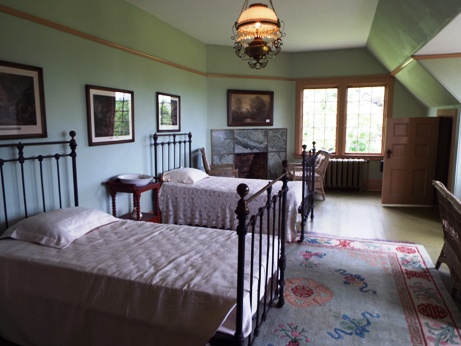
The home contains 11 bedrooms.  Because the island was accessible
only at low tide, visitors often spent the night at the house.
The Covenhoven property also includes a barn built to house the owner's prized Clydesdale horses and Dutch Belted cows.  It was built by unemployed shipbuilders and the craftsmanship is superb.  Frankly, I found the barn more architecturally interesting than the house!  Three stories tall, the barn includes a freight elevator.  Each floor covers 8,300 square feet (771 square meters). The barn cost $20,000 to build in 1898.  It is currently undergoing a five-year, 1.5 million dollar restoration. 
Phase 1 of the barn restoration will be a $260,000, 2-year 
restoration of the roofs and ventilators on the twin 16-foot
diameter silos, which can hold a total of 110 tons of fodder.
The windmill provided running water to the home, long before running
water was common in homes. The small structure is a natural gas
well, which provided gas in the home for lights and cooking.

While at St. Andrews we had the occasion to visit the nearby town of St. Stephen - or rather the emergency room at Charlotte County Hospital.  That stop was NOT part of our itinerary.  Our friend Lilian had a minor but painful mishap that resulted in a broken toe.  The original plan was for the four of us to meet mutual friends in Lake George, New York but on the advice of the doctor, Guy and Lil  decided to head back to Chelmsford while Mike and I continued on to New York.

Dramatic costal tides, geologic treasures, a charming resort town, and a trip to the emergency room...such is the stuff of Road Stories


This MG TD was in the Canada Day Parade and car show in St. Andrews.
It and Yvonne are the same age, and both still look pretty damn good.